In short
You can't verify what you don't understand, and understanding is exactly what atrophies when AI does the work for you.
Four photographs. Click the ones you think are AI-generated, then check your picks.
I've run that quiz several times over the past few years, when facilitating workshops, with interns, at my own kitchen table. The pick interests me less than what comes next, when I ask how they knew. The answers are always the tells: shadow, fingers, skin that's too smooth. Distinguishing real from AI-generated images is the most obvious place to expose a problem that runs through everything, from the forwarded news story to a summary an AI sends just before a meeting.
The stakes are high, and the problem is getting worse. Not only because the quality of AI-generated content is improving, but also because people are losing the ability to verify information, or even consider when they should.
How we got here
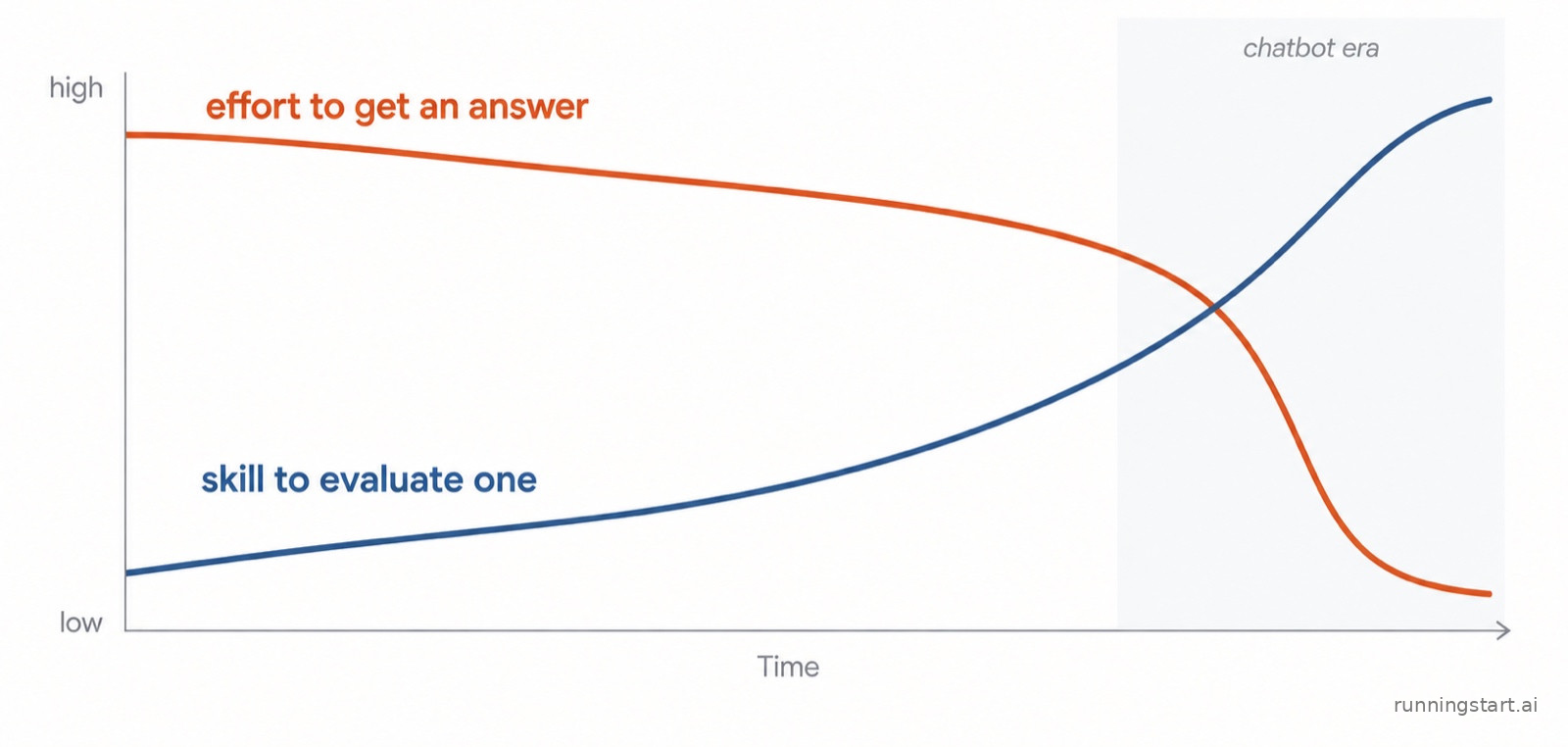
As the effort to get an answer approaches zero, the skill needed to evaluate one goes up. The graph illustrates the point. Most of our habits were built when finding information took effort, and experts did the filtering for us. The card catalog, asking the reference librarian, even the wall of Google's blue links each weeded something out. Now the answer arrives instantly, explained like it came from someone who knows.
-
THROUGH THE LATE 1990s
The library era
High effort. The effort was the filter.By the time you found the thing it had passed through librarians, editors, and peer review. Institutions did the evaluating, slowly.
-
2000s TO EARLY 2020s
The Google era
Low effort. Garbage mixed in.A blog could outrank a journal. Evaluation became the reader's job for the first time at scale, and we adapted unevenly (is it .edu or .com?).
-
LATE 2022 TO ABOUT PRESENT
The ungrounded chatbot era
Zero effort. No sources at all.Fluent answers with nothing behind them, right or wrong with the same straight face. Most of the world met AI here, and a lot of mental models froze here.
-
ROUGHLY 2024 TO NOW
The grounded era
Zero effort. Sources rebuilt, imperfectly.AI that retrieves from real documents and cites them, but only when the tools are set up to use the feature. In every room I teach, the fast sourceless reply is still (as of July 2026) what most people use, and it is the weakest version available.
Why fluency fools us
AI produces polished output whether it's right or not. Wrong answers aren't new. What's new is that the tone never changes. No stammer, no hedge, no seam between the accurate paragraph and the invented one.
Almost everyone I teach is running an understanding of AI calibrated to early 2023. It was early, and nothing ever forced an update.
That freeze matters. The most useful thing to know about a chatbot's answer today is whether it's grounded in real sources it can cite or generated from predictions based solely on its original training.
The skill that lasts
Spotting fakes doesn't hold up. Those tells, the weird hands, the shadows, the too-smooth skin, would have worked in 2022, but current models pass all of them. Every release resets the list. And there is no simple tell for an invented statistic or misattributed quote.
The skill to learn (and teach) is to stop asking whether the content looks real. Ask where it came from (one of several Durable Skills).
The question that expires
"What's wrong with this picture?"
The question that doesn't
"Who made this, and who can confirm it?"
That question worked for newspapers in the 20th century, works for Google results, and works for AI's output. Mike Caulfield gave the method a name, SIFT: Stop, Investigate the source, Find better coverage, Trace the claim back to where it started.
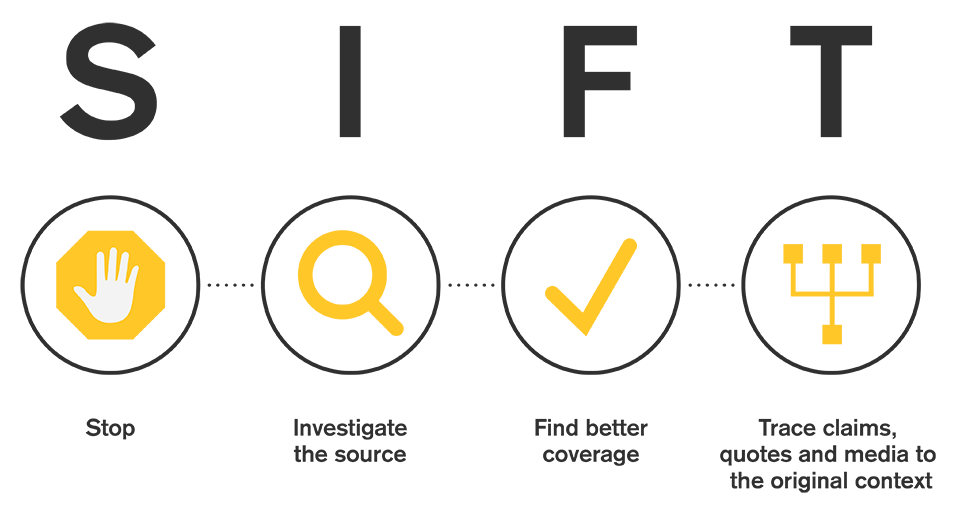
Which brings us back to the four images at the top. The test eventually showed you the answer, but the answer teaches you nothing you can use the next time an image comes to you via whatever social media you use. Where did the image first appear? Who published it? Does a reverse image search show the source?
You can't verify what you don't understand
SIFT tells you where to look. It doesn't tell you what you're looking at.
To catch a number doing something dishonest, you have to know what it measures. To see what a confident paragraph left out, you have to know what belonged there. To judge a source, you need enough of the field in your head to tell credible from merely confident. Verification isn't just a series of steps. It runs on everything you already understand.
Keep the reps
Understanding accumulates as things get encoded and then used, until you can feel when a new claim doesn't sit right. Encoding is the raw material, and encoding takes effort.
This summer I told two interns that if they remembered one thing, it should be this: keep learning, especially as automation gets good. I said it was the most important thing I had for them. When I asked the next day what their key takeaway had been, neither could tell me what it was.
Of course they forgot. I handed them a conclusion, and conclusions don't stick. I've spent my career designing learning, I know this cold, and I still defaulted to telling. The forgetting wasn't their failure. It was the thing I was warning them about, happening live.
Bjork named this in 1994. Desirable difficulties: conditions that make practice feel harder, like testing yourself before rereading, produce learning that lasts. Smooth conditions produce performance that evaporates. The struggle encodes the information in your brain.
Ease feels like progress, and the research keeps finding it's usually the opposite.
A frontier model is the smoothest experience ever built. It removes the retrieval attempt, the false start, the blank page, the weighing of sources. Every one of those was friction that made you think. Aviation learned this decades ago. As autopilot got good, regulators started pushing airlines to put pilots back on manual flight, because the better the automation, the rustier the human it hands the plane back to.
For adults that's atrophy. You built the skill the slow way, nothing in your day requires it now, and nothing announces the loss. It shows up later as something you used to be able to do or know that you can no longer do or retrieve. Which is why the gym is the right comparison, and why it's preventive. Nobody lifts weights because the barbell needs to be moved. The upside of staying sharp enough to work with these tools is a separate argument.
The friction that trains you takes a few forms:
- Retrieving instead of rereading.
- Generating your answer before seeing one.
- Spacing instead of cramming.
AI's whole product is removing difficulty, and often that's exactly what you want. So I sort friction into two piles, the kind that only slows me down and the kind that keeps me sharp. Only one of those should go. For example, I still take meeting notes, then use the AI version to flesh them out. Relying only on the AI leaves an unchecked record outside my head, and me unprepared to push back in real time in the next meeting.
For parents and teachers
Adults are protecting something they already built. We run the risk of raising children who never build it at all. A kid raised using effortless "answer engines" doesn't atrophy because there's nothing there yet to lose, and a mind with nothing encoded has nothing to verify against.
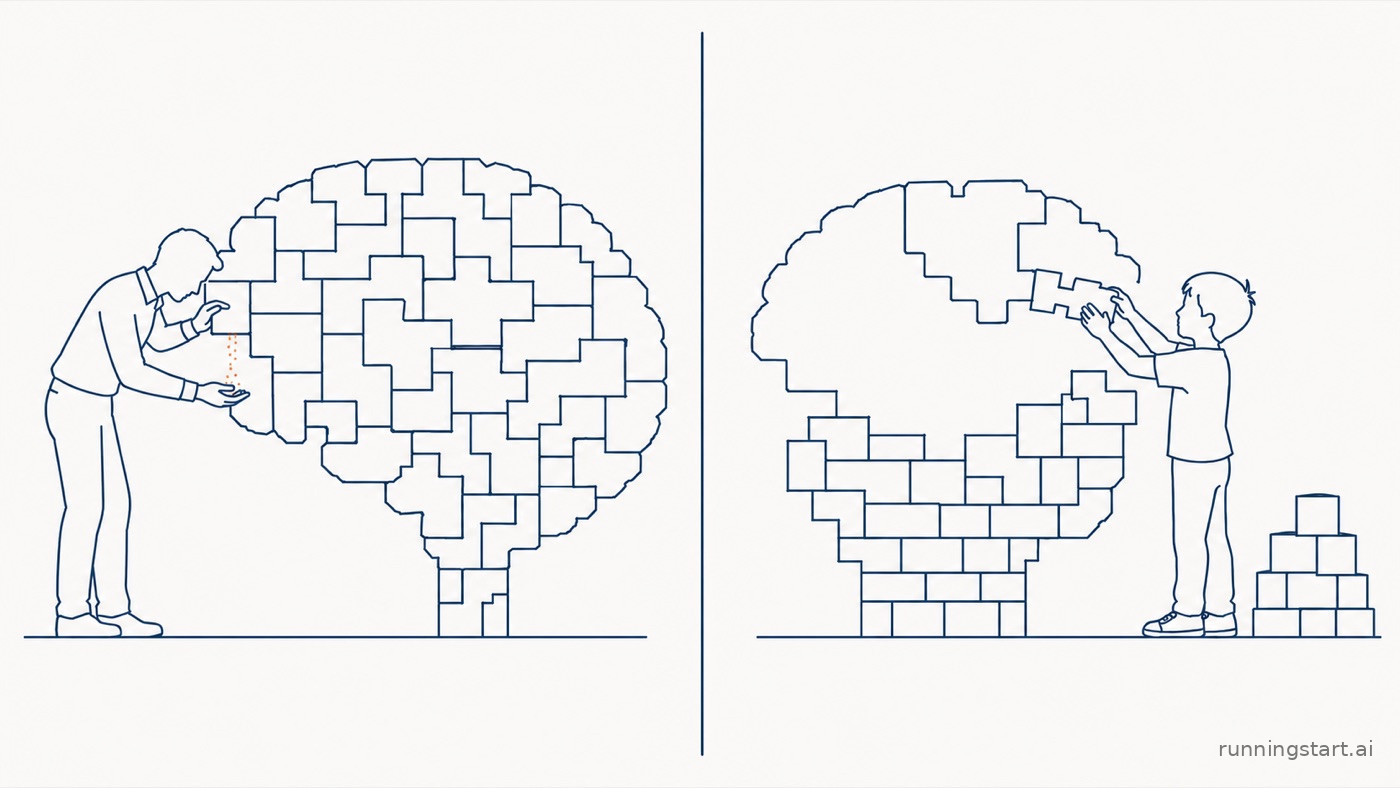
I want my kids using these tools. The question is whether anything in their day still asks them to retrieve, to generate, to check, to sit with not knowing and struggle.
Every gym in January is full of people who know exercise matters. By March, the people still there are the ones who found a way to want it. Similarly, we need to build friction into our daily lives and cultivate an appetite for desirable difficulties in our children.
Sources. Desirable difficulties is Robert Bjork's. The SIFT method is Mike Caulfield's. The three real photographs in the opening test, the water, the papayas, and the sunset, are by Marissa Rodriguez. I generated the peaches with ChatGPT in July 2026.
Keep reading
October 2026 Automatic to Autonomous AI agents can now act on your behalf, and one Approve button might authorize more than you think. Your AI policy has to move with them. September 2026 Human in the Lead AI-powered tools can now clear your backlog. What are the implications, and how do we manage the higher-order effects? February 2026 Durable Skills Nine skills I would still teach a kid or train an adult on for the foreseeable future, each with a short example.Feed
 The knowledge canyon
Too much sci-fi has us stuck speaking in the wrong verb tense. The old digital divide was about access. This one is harder to see.
→
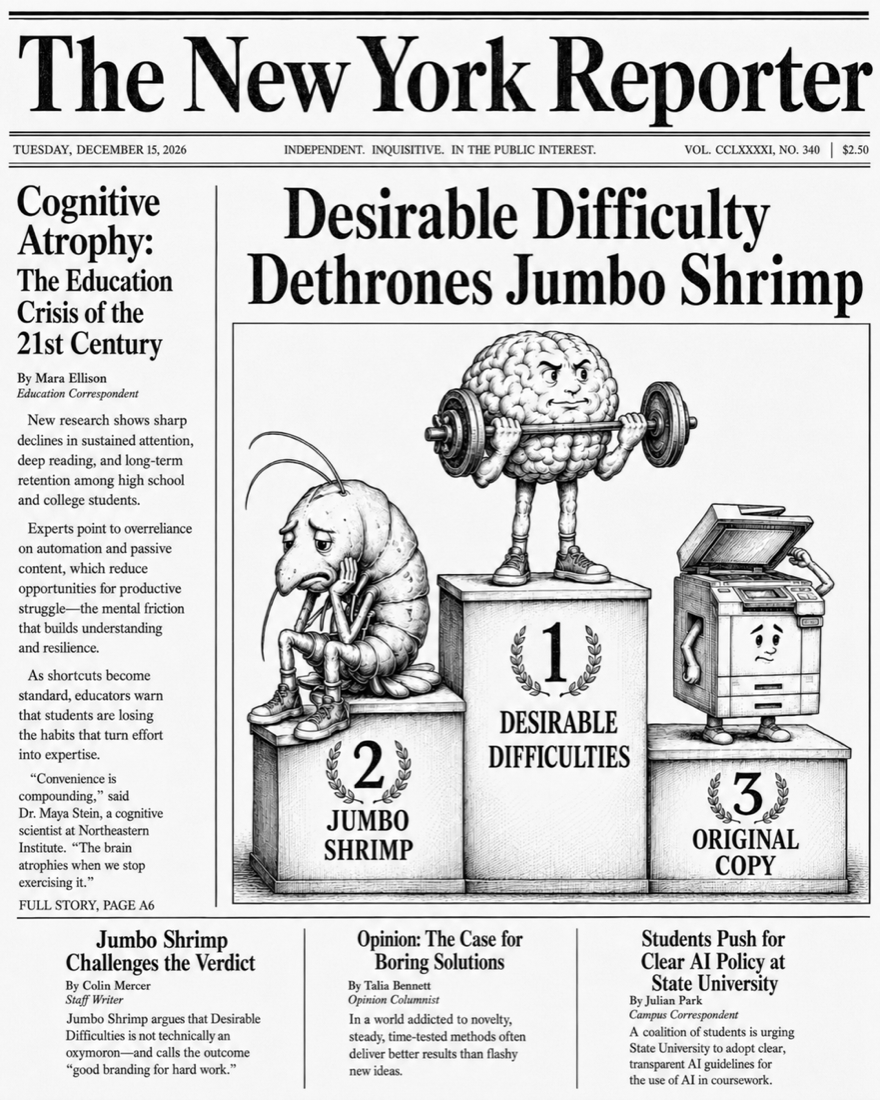 No pain no brain
The risk of AI eroding our knowledge and skills is getting more attention lately. When we delegate too often, we atrophy.
→
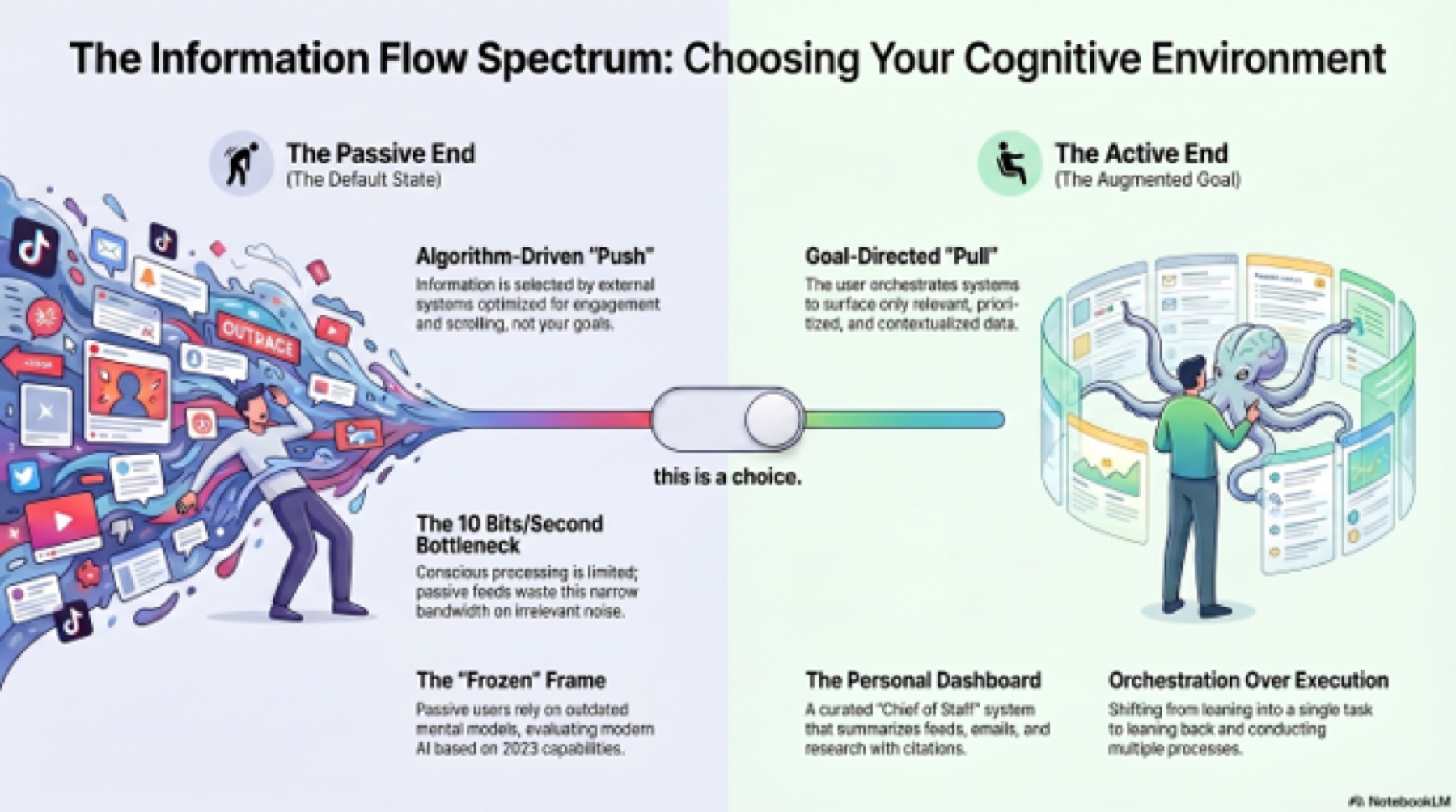 Your feed needs a chief of staff
Agentic AI offers a chance to move from TikTok-passive, where algorithms dictate our attention, to more of a chief-of-staff relationship.
→
See the full feed